
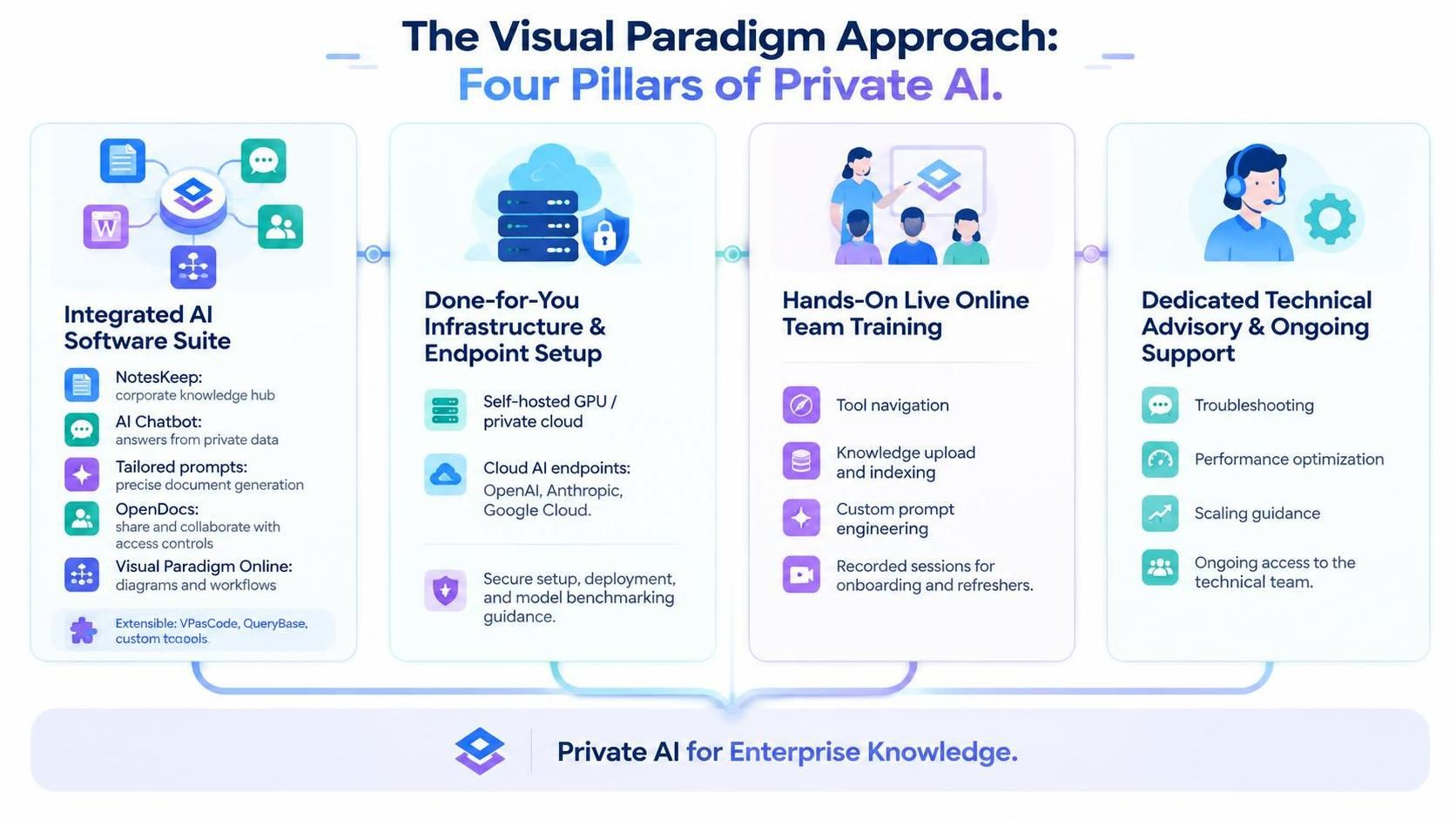
In the rapidly evolving landscape of enterprise technology, the gap between the potential of Artificial Intelligence and the reality of secure, scalable deployment is often bridged by a “Private AI” architecture. The Visual Paradigm solution offers a comprehensive framework, moving beyond simple tool integration to provide a holistic ecosystem. This tutorial deconstructs the Visual Paradigm Approach: Four Pillars of Private AI, explaining how a self-hosted, private AI solution is architected to empower enterprise knowledge management without compromising security.
Pillar 1: The Integrated AI Software Suite (The Application Layer)
The foundation of the ecosystem is the software suite itself. Unlike standalone tools that require manual data wrangling, this approach utilizes a suite of tools that are natively integrated to bind directly to your private Large Language Model (LLM) endpoint. This architecture ensures that data remains within the defined perimeter of your control.
Core Components of the Suite
- Visual Paradigm NotesKeep: Acting as the central nervous system for information, this is not just a note-taking app but a centralized repository. It aggregates corporate assets, casual notes, meeting summaries, and project documentation into a unified knowledge base.
- Visual Paradigm AI Chatbot: This is the interface for the user. It functions as an advanced Knowledge Analysis Chatbot. By connecting to the NotesKeep repository, it answers queries based on private data, providing context-aware responses that are accurate to your organization’s specific context.
- Tailored AI Prompts: To reduce the noise of generative AI, this system utilizes pre-engineered prompts. These are specialized instructions designed for precise document generation, such as creating product specifications, requirement documents, or executive summaries.
- Visual Paradigm OpenDocs: Once content is generated or analyzed, it must be shared. This platform facilitates publishing and collaborating on AI-generated content, utilizing role-based access controls to ensure the right people see the right information.
- Visual Paradigm Online: The visual layer of the ecosystem. This robust Diagram Editing Tool allows users to visualize processes, architectures, and workflows, bridging the gap between abstract text and structured visual data.
Extensibility: The architecture is designed to be fluid. It is not a static list of features but an extensible suite capable of incorporating applications like VPasCode for code generation and review, or QueryBase for structured data querying.
Pillar 2: Done-For-You Infrastructure & Endpoint Setup (The Data Layer)
The most significant barrier to Private AI is the complexity of infrastructure. This pillar addresses the “How” of deployment. The architecture offers two distinct routing models for your data, managed by the Visual Paradigm team to eliminate technical friction.
Infrastructure Options
- Option A: Self-Hosted Dedicated GPU / Private Cloud
This is the gold standard for maximum privacy. The entire stack—data, model, and application logic—runs on hardware within your control (e.g., AWS EC2 GPU instances or on-premise private cloud). This ensures zero data egress to public model providers.
- Option B: Cloud AI Endpoint Connection
For organizations that prefer managed services, this route connects via direct API token providers such as OpenAI, Anthropic, or Google Cloud. Crucially, this connection is secured with strict data governance policies, ensuring that even when using cloud endpoints, the data flow is governed by enterprise security standards.
Model Selection & Benchmarking: The system includes internal LLM benchmarking guidance. This helps architects select the right models for specific use cases, ranging from high-speed operational models (e.g., variants optimized for speed like gpt-5.6-luna, claude-sonnet-4-6, gemini-3.7-flash) to specialized reasoning models for complex tasks.
Pillar 3: Hands-On Live Online Team Training (The Human Layer)
A technical architecture is only as strong as the users interacting with it. This pillar focuses on the operationalization of the system. The training is not just a manual; it is an interactive, live online session.
The curriculum is designed to cover three critical areas:
- Tool Navigation: Ensuring users can effectively use the interface.
- Knowledge Management: Strategies for uploading and indexing knowledge so the AI can retrieve it accurately.
- Prompt Engineering: Teaching users how to craft custom prompts to extract the highest value from the LLM.
Pillar 4: Dedicated Technical Advisory & Ongoing Support (The Governance Layer)
Finally, the architecture is supported by a dedicated technical team. This ensures that the system does not just “work” initially but continues to run smoothly and efficiently. This support layer covers:
- Troubleshooting operational issues.
- Performance optimization (tuning the system for speed and cost).
- Scaling guidance (expanding the system as the organization grows).
Conclusion: The Total Solution
The Visual Paradigm Approach transforms Private AI from a fragmented technical challenge into a cohesive, managed service. By integrating the software suite, infrastructure setup, human training, and ongoing support, organizations can kickstart a Private AI ecosystem that delivers immediate value while maintaining strict data sovereignty.