
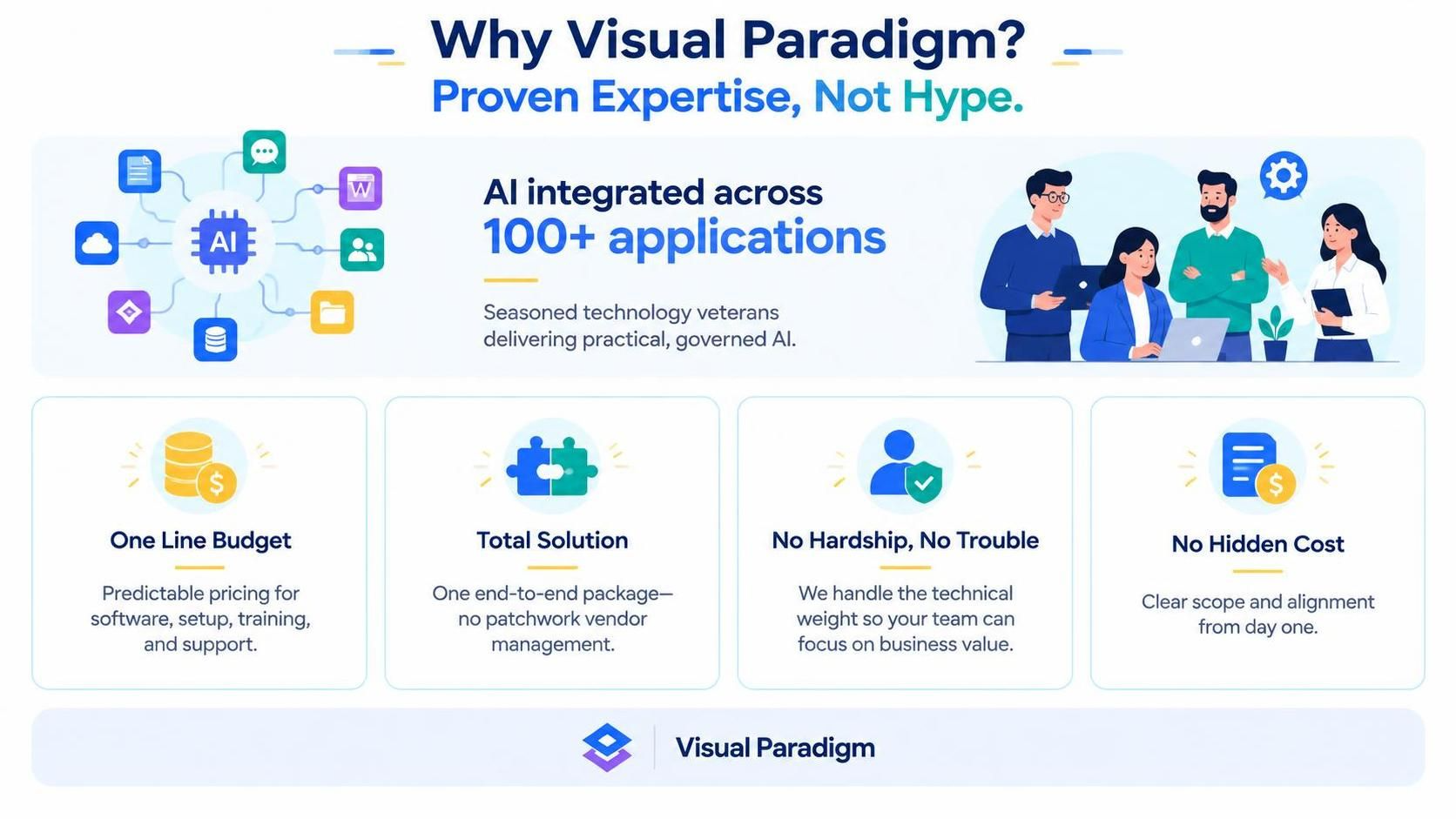
In the rapidly evolving landscape of enterprise technology, the shift from theoretical AI to practical, governed implementation is the defining challenge of the decade. Visual Paradigm’s “Self Host AI Total Solution” represents a paradigm shift away from fragmented vendor management and towards a unified, secure, and architecturally sound ecosystem. This tutorial explores the system architecture behind this Total Solution, focusing on how enterprise-grade AI is integrated, secured, and deployed without the traditional overhead of “hype.”
Understanding the Self-Hosted AI Architecture
The core of the Visual Paradigm offering is not merely a collection of tools, but a cohesive system architecture designed for the modern enterprise. Unlike consumer-grade AI that relies on public clouds and opaque APIs, a Self-Hosted AI Ecosystem operates within the organization’s own secure perimeter. This architecture prioritizes data sovereignty, ensuring that sensitive corporate information never leaves the controlled environment.
1. The Central AI Brain
At the heart of this ecosystem lies the central AI component. This is not a simple chatbot interface but a sophisticated orchestration layer. It serves as the “brain” that connects various enterprise applications and data sources. By integrating across more than 100 applications, this architecture ensures that AI capabilities are ubiquitous throughout the organization, from document management to customer relationship systems.
- Orchestration: The central node manages requests, routing them to the appropriate model or service.
- Context Awareness: It maintains the context of interactions, allowing for complex, multi-step workflows.
- Integration Hub: It acts as the bridge between legacy systems and modern AI capabilities.
2. Secure Endpoint Configuration
A critical aspect of this architecture is the configuration of endpoints. In a self-hosted environment, the “endpoints” are the entry and exit points for data processing. Visual Paradigm’s approach ensures that these endpoints are configured with rigorous security protocols.
This involves:
- Authentication: Ensuring only authorized personnel and systems can access the AI models.
- Encryption: Data in transit and at rest is encrypted to prevent interception.
- Access Control: Granular permissions ensure that data access aligns with enterprise governance policies.
3. Model Training and Governance
The architecture supports a “Train Securely” methodology. This means that the models used within the ecosystem can be fine-tuned on proprietary data without compromising security. This is essential for enterprises that require specialized AI behavior based on their unique business processes.
Enterprise Data Governance: The system is designed to respect and enforce data governance rules. This includes data lineage tracking, audit logging, and compliance with regulations such as GDPR or HIPAA. The architecture ensures that AI decisions are transparent and explainable.
The “Total Solution” Philosophy
Visual Paradigm’s approach to the “Total Solution” is a holistic view of software delivery. It moves beyond the traditional “patchwork” method of buying individual tools and stitching them together. Instead, it offers a complete end-to-end package.
- Unified Interface: Users interact with a consistent interface, regardless of the underlying complexity.
- Seamless Integration: The system integrates with existing workflows without requiring disruptive changes.
- Comprehensive Support: From setup to training, support is provided as a single point of contact.
One Line Budget
One of the most significant benefits of this architecture is the financial predictability it offers. The “One Line Budget” concept simplifies the financial planning process for IT leaders. It encompasses all costs—software, setup, training, and support—into a single, transparent line item.
This eliminates the “hidden costs” often associated with enterprise AI projects, such as unexpected licensing fees, integration costs, or the need for specialized consultants. It allows organizations to forecast their AI investment with precision.
Technical Implementation and Modeling
To visualize and implement this architecture, Visual Paradigm utilizes advanced modeling capabilities. While the specific implementation details are complex, the high-level architecture can be represented through system diagrams.
For instance, a Data Flow Diagram (DFD) could illustrate how data moves from the user, through the central AI brain, to the various applications and back. A Sequence Diagram could detail the interaction between the client, the API gateway, and the AI models.
Conclusion
The Visual Paradigm Self-Hosted AI Total Solution represents a mature, veteran approach to enterprise AI. It moves beyond the hype of “newcomers experimenting with AI” and offers a proven, secure, and integrated ecosystem. By focusing on data governance, secure endpoint configuration, and a unified “Total Solution,” Visual Paradigm empowers organizations to unlock the true value of AI without the technical burden.
Whether you are a seasoned technology veteran or a business leader looking to transform your operations, this architecture provides the foundation for a successful AI journey. With a “One Line Budget” and a commitment to “No Hardship, No Trouble,” Visual Paradigm ensures that your internal teams can focus on what matters most: delivering core business value.