
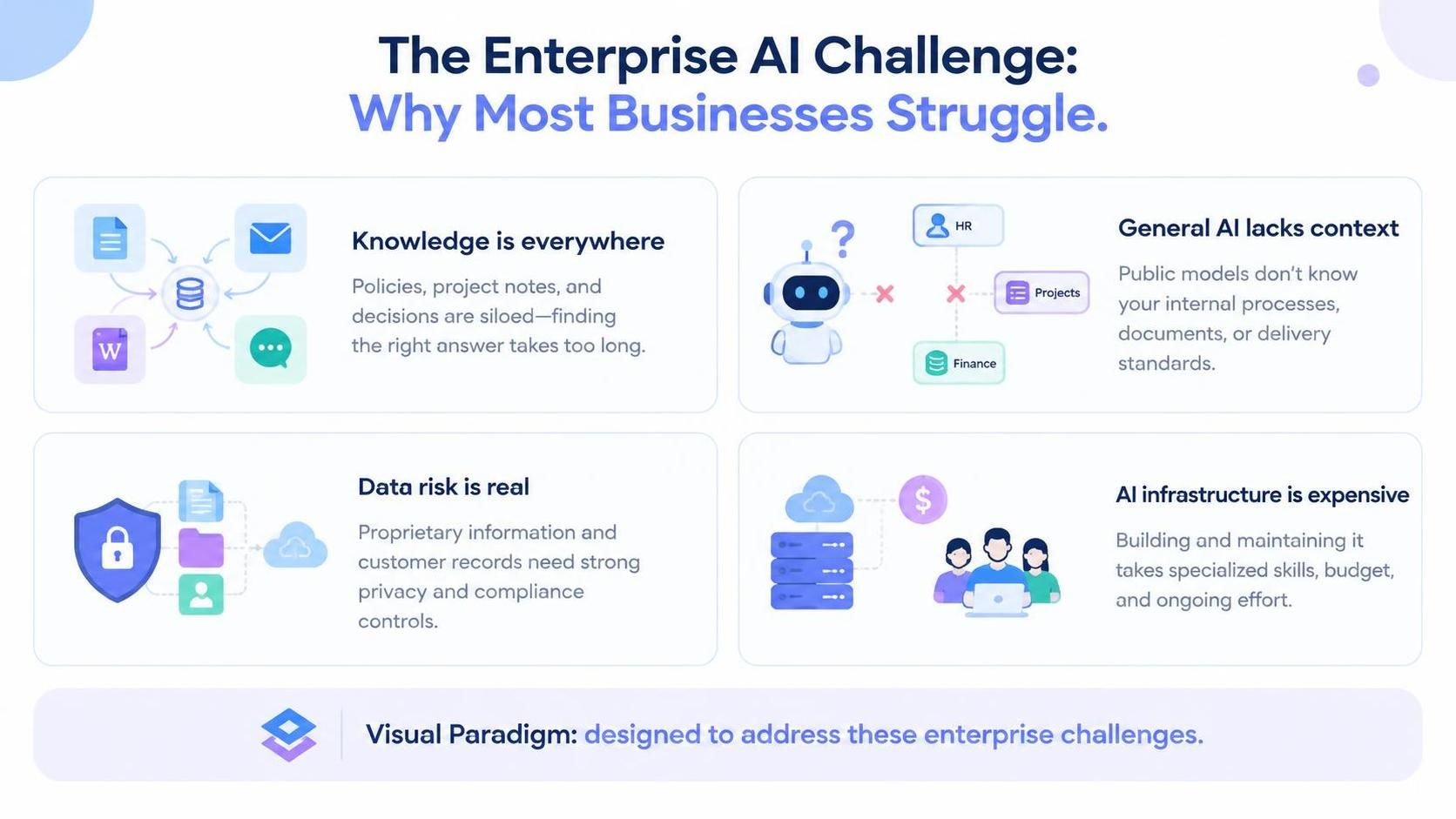
Enterprise adoption of Artificial Intelligence has long been held back by a paradox: while the technology promises efficiency, the infrastructure required to make it safe and useful often feels too complex, too expensive, or too risky for traditional business environments. The image provided highlights four critical barriers that organizations face—fragmented knowledge, lack of context, data privacy risks, and infrastructure costs.
This tutorial explores the architectural philosophy behind a Self-Hosted AI Total Solution. We will deconstruct how the Visual Paradigm AI Ecosystem addresses these specific pain points, moving from the chaotic state of siloed data to a unified, secure, and context-aware enterprise intelligence system.
1. Solving the Knowledge Silo: Centralized Information Retrieval
The first challenge illustrated in the context diagram is the fragmentation of corporate knowledge. In a typical enterprise, policies live in Word documents, project notes reside in wikis, and decisions are buried in email threads or chat logs. This creates a “needle in a haystack” scenario for employees.
The Enterprise AI Ecosystem addresses this by acting as a unified indexing layer. Instead of employees searching through disparate repositories, the system ingests these various data sources into a centralized architecture.
- The Problem: Information is scattered across files (DOCX), communication platforms (Email, Slack/Teams), and databases.
- The Architectural Solution: A unified ingestion pipeline connects these sources. The system doesn’t just store the data; it indexes it, creating a semantic map that allows the AI to retrieve answers based on meaning rather than just keywords.
- The Outcome: When an employee asks a question, the AI aggregates relevant information from the “everywhere” locations to provide a synthesized answer.
2. Bridging the Context Gap: Domain-Specific Intelligence
Public AI models (often referred to as “General AI”) are powerful but generic. They lack the “insider” knowledge of how a specific company operates, its proprietary methodologies, or the nuances of its customer-specific configurations. The diagram illustrates this with a robot confused by connections to HR, Projects, and Finance.
To solve this, the Visual Paradigm solution moves beyond generic Large Language Models (LLMs) to a Context-Aware Architecture.
This architecture typically employs a technique known as Retrieval-Augmented Generation (RAG). The system does not rely solely on the model’s pre-trained memory. Instead, it performs the following steps:
- Retrieval: The system queries the internal knowledge base for specific documents or policies relevant to the user’s prompt.
- Augmentation: It injects this retrieved context into the prompt sent to the AI engine.
- Generation: The AI answers the question using both its general reasoning skills and the specific internal data provided.
By grounding the AI in internal data, the system understands the company’s specific workflows, ensuring that the output is relevant to the enterprise’s unique standards.
3. Mitigating Data Risk: The Self-Hosted Privacy Model
Data privacy and compliance are non-negotiable for large enterprises. Sending sensitive customer records or proprietary intellectual property to a third-party cloud AI service introduces unacceptable risks regarding data leakage and regulatory violations.
The solution lies in the Self-Hosted nature of the deployment. Unlike SaaS (Software as a Service) models where data leaves the corporate network, a self-hosted ecosystem operates entirely within the organization’s secure perimeter.
- Data Sovereignty: The data never leaves the corporate firewall. The AI model runs on the company’s own infrastructure (or a private cloud), ensuring that sensitive information remains under the organization’s strict control.
- Access Controls: This setup allows for granular Role-Based Access Control (RBAC). The system can be configured to ensure that an AI query from the HR department cannot accidentally retrieve financial records from the Accounting department.
- Compliance: This architecture aligns with strict regulatory standards (such as GDPR, HIPAA, or SOC2) that prohibit external data processing for sensitive information.
4. Reducing Infrastructure Costs: The “No-Code” AI Strategy
One of the most daunting aspects of AI implementation is the “Engineering Tax.” Building a custom AI environment usually requires a dedicated team of Data Scientists and AI Engineers to manage infrastructure, model tuning, and integration. The diagram highlights that this is often too expensive for many businesses.
The Visual Paradigm ecosystem is designed to democratize AI by providing a Low-Code/No-Code platform. This approach significantly reduces the barrier to entry and ongoing maintenance costs.
Key architectural features that reduce engineering overhead include:
- Pre-Built Integrations: Instead of writing custom connectors for every data source, the ecosystem offers out-of-the-box adapters for common enterprise tools.
- Visual Modeling: Architects can design AI workflows and decision logic visually, rather than writing complex Python scripts. This allows business analysts to participate in the system design.
- Managed Infrastructure: The solution abstracts away the underlying complexity of GPU management and model serving, allowing the organization to focus on the business value rather than the server maintenance.
Conclusion
The transition from a struggling enterprise to an AI-enabled organization is not merely about buying a chatbot; it is about architecting a system that respects the complexity of the business. By addressing knowledge fragmentation, providing domain-specific context, ensuring data privacy through self-hosting, and minimizing infrastructure costs via a unified ecosystem, Visual Paradigm provides a robust foundation for the future of enterprise intelligence.