
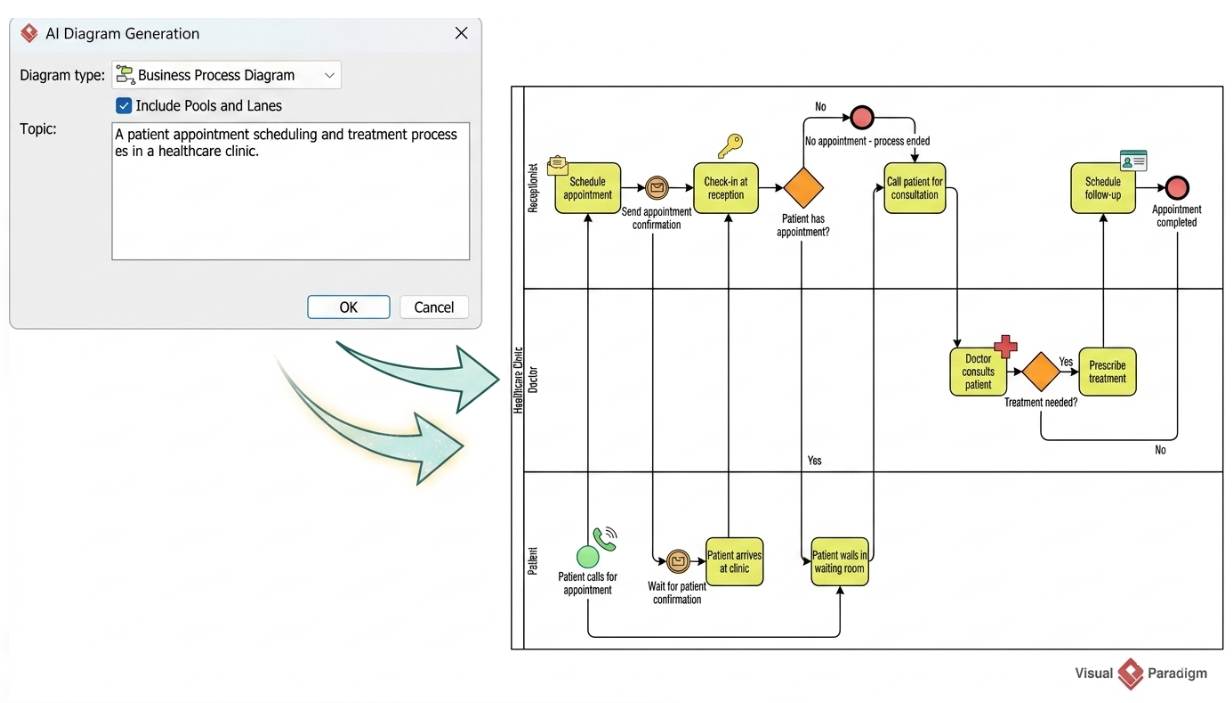
In the realm of business process management, the gap between a high-level idea and a formalized, executable model has traditionally been bridged by manual, time-consuming diagramming. However, the integration of Artificial Intelligence into tools like Visual Paradigm has fundamentally shifted this paradigm. This tutorial explores the architecture of AI-assisted BPMN modeling, specifically focusing on how plain-language descriptions are transformed into rigorous, multi-party workflows. We will deconstruct the process of generating a healthcare clinic workflow, analyzing the structural integrity, the logic of message flows, and the specific roles of participants.
1. The Architecture of AI-Generated Modeling
The core concept behind the interface shown in the image is the transformation of “unstructured data” (text) into “structured data” (BPMN XML). When a user inputs a narrative description, the AI engine does not merely draw shapes; it parses the semantic relationships between entities.
The architecture operates on three distinct layers:
- Input Parsing: The system identifies actors (e.g., “Receptionist”, “Patient”), actions (e.g., “Schedule appointment”), and triggers (e.g., “Patient calls”).
- Structural Inference: Based on the input “A patient appointment scheduling… process”, the system infers a multi-pool structure. It recognizes that a “Clinic” and a “Patient” are distinct organizational entities that require separate containers.
- Logic Synthesis: The AI maps the temporal sequence. It understands that “Check-in” must precede “Consultation,” and it introduces decision gateways (diamonds) based on conditional logic like “Patient has appointment?”.
2. Deconstructing the Clinic Workflow Model
Let us analyze the resulting diagram to understand the specific architectural patterns employed. The model represents a classic “Orchestration” pattern, where a central entity coordinates the process, but it also utilizes “Choreography” elements to define external interactions.
2.1 The Three-Pool Structure
The diagram effectively separates the ecosystem into three distinct pools, a critical best practice for clarity:
- The Patient Pool: Represents the external entity. Note that this pool contains the initiation event (the phone call) and the waiting state. It demonstrates the “black box” nature of the customer in the system’s view.
- The Receptionist Lane (Clinic): This lane handles the administrative orchestration. It manages the “Schedule appointment” task and the “Check-in at reception” verification.
- The Healthcare Clinic / Doctor Lane: This represents the core value-add of the business. It contains the complex decision logic regarding “Treatment needed?” and the specific medical actions.
2.2 Message Flows vs. Sequence Flows
One of the most subtle but vital architectural decisions in BPMN is the distinction between internal flow and external communication.
- Sequence Flow (Solid Arrow): Used exclusively within the “Healthcare Clinic” pool. For example, the flow from “Call patient for consultation” to the gateway “Patient has appointment?” represents a single thread of control within the receptionist’s domain.
- Message Flow (Dashed Arrow): Crucially, observe the interaction between the “Receptionist” and the “Patient”. The arrow crossing the boundary between pools is a message flow. This signifies an exchange of information (e.g., the appointment confirmation) rather than a direct hand-off of control. This distinction is vital for defining system boundaries and compliance.
3. Logic and Exception Handling
A robust process model must account for the “Happy Path” (everything goes right) and the “Unhappy Path” (exceptions). The AI has successfully generated a logic tree that handles the negative scenario.
Consider the Gateway labeled Patient has appointment?:
- The “Yes” Path: The process continues to the consultation phase, moving down to the “Doctor” lane.
- The “No” Path: If the patient arrives without an appointment, the flow leads to an “End Event” (the red circle). This immediately terminates the process instance, preventing resource waste. This is a critical piece of logic that might be missed in manual drafting but is logically deduced by the AI.
4. The Human-in-the-Loop: Review and Refinement
While the AI generates a functional draft, the “Modeling” phase is not complete. The generated diagram serves as a “living document” that requires human validation. The next steps for a technical architect would be:
- Validation of Gateways: Does the “Treatment needed?” decision correctly map to the “Prescribe treatment” activity? Is there a clear path for “No”?
- Timer Verification: The prompt mentions “Wait for patient confirmation.” In a real system, is there a timeout? If the patient never arrives, does the system hold the slot indefinitely?
- Exception Handling: What happens if the “Doctor consults patient” task fails or the doctor is unavailable? The current model assumes a successful completion.
Conclusion
The transition from a simple text prompt to a complex BPMN diagram illustrates the power of AI-assisted modeling. By automating the syntax and structural layout, the AI allows architects to focus on the “Why” and “How” of the process logic rather than the “Where” and “When” of the drawing. The resulting diagram is not just a picture; it is a formal specification of the clinic’s operational reality, ready for discussion, refinement, and potentially execution.