Imagine having a powerful, AI-powered tool that can instantly generate a comprehensive strategic plan for your business, guiding you through the complex process of anticipating future market conditions. The AI-Powered Scenario Analysis Tool from Visual Paradigm does exactly that, transforming strategic foresight from a daunting task into a streamlined, data-driven process. This article provides a step-by-step walkthrough of how this innovative tool can be used to build a robust strategic outlook for an omnichannel retailer like OmniRetail Group. By following the guided workflow, users can explore multiple plausible futures, assess their potential impacts, and develop proactive responses—all within a single, intuitive application. The result is a professional, actionable report that empowers leaders to make informed decisions in an uncertain world.
-
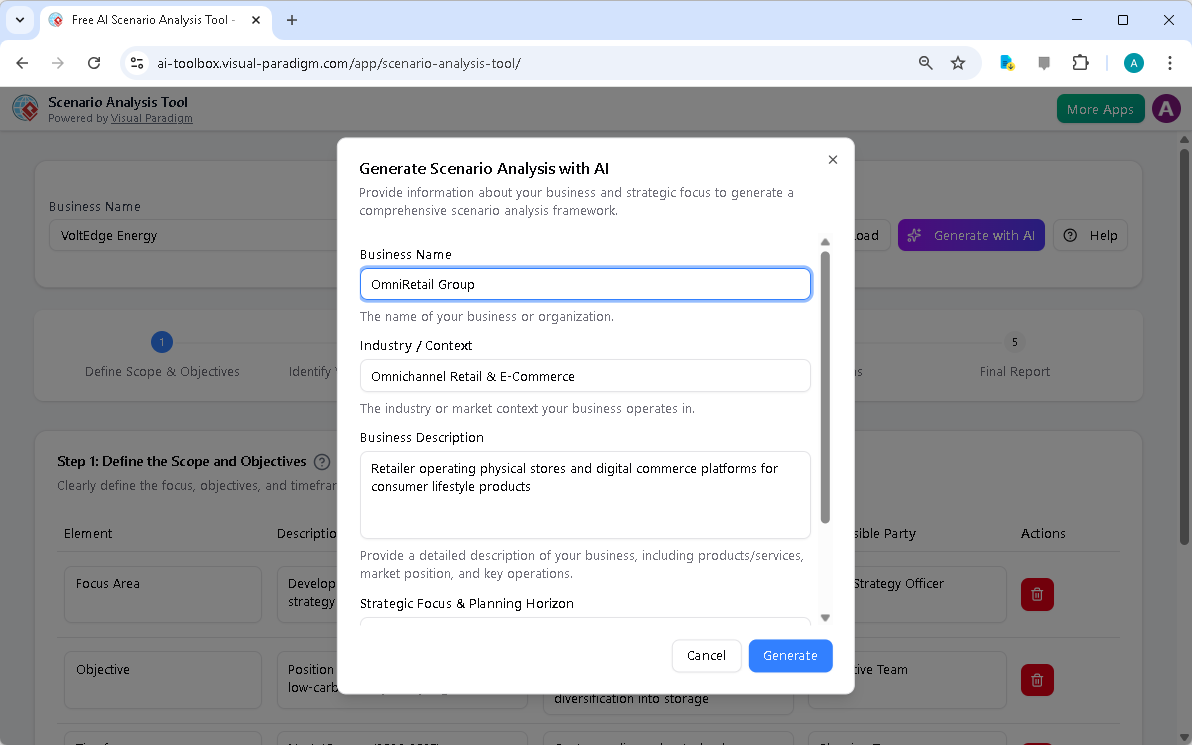
Define Your Business Context: Start by inputting your business name, industry, and a detailed description of your operations and strategic goals. This foundational information is crucial for the AI to generate relevant and tailored insights.
-
Generate a Comprehensive Analysis: The AI will then create a full scenario analysis, outlining the scope, key variables, potential scenarios, their impacts, and strategic responses.
-
Review and Refine: Navigate through each of the five steps, reviewing the AI’s suggestions and editing them to reflect your team’s expertise and specific market knowledge.
-
Generate a Professional Report: Compile all your analysis into a final, polished report that can be easily shared with stakeholders and used for strategic planning.
Step 1: Define the Scope and Objectives
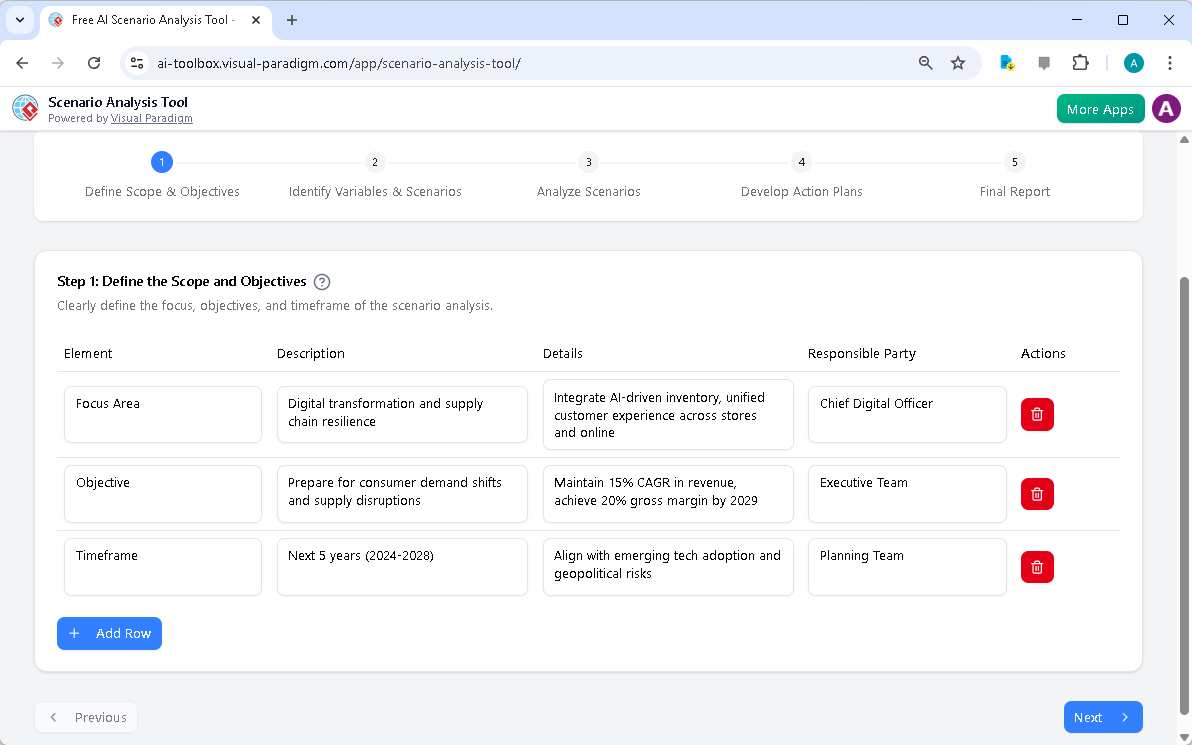
The journey begins with a clear definition of the scope, objectives, and timeframe for the scenario analysis. As shown in the image below, the tool guides the user through this initial phase. The focus area is defined as “Digital transformation and supply chain resilience,” which is a critical strategic priority for an omnichannel retailer. The objective is to “Prepare for consumer demand shifts and supply disruptions,” highlighting the need to be agile in a volatile market. The timeframe is set for the next five years (2024-2028), providing a concrete horizon for the analysis. The tool’s structured table format allows for easy input of these elements, with each row representing a distinct component of the strategic plan. The responsible parties for each element are also clearly assigned, ensuring accountability and alignment across the organization. This initial step sets a strong foundation, ensuring that the entire analysis is focused on the most critical business challenges and opportunities.
Step 2: Identify Key Variables and Scenarios
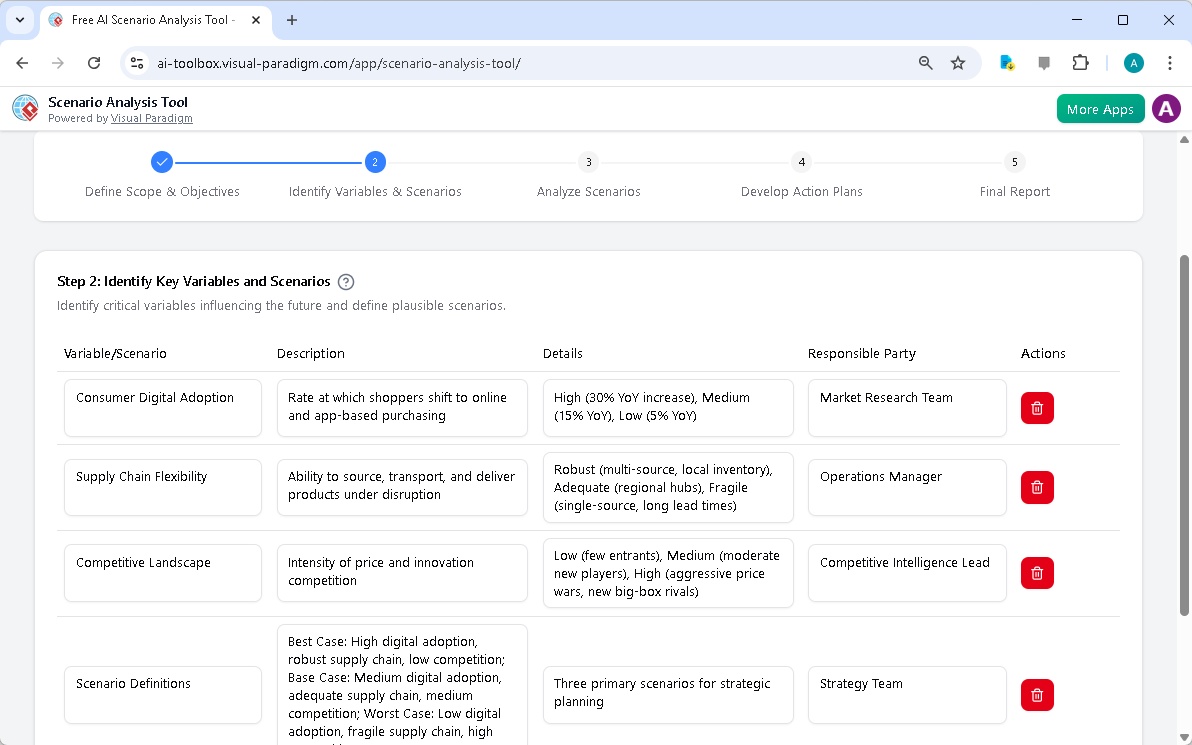
With the scope defined, the analysis moves to identifying the critical uncertainties that will shape the future. The image below illustrates this crucial step. The tool prompts the user to consider key variables such as “Consumer Digital Adoption,” “Supply Chain Flexibility,” and “Competitive Landscape.” For each variable, the AI provides a description of its nature and potential outcomes. For instance, “Consumer Digital Adoption” is defined by the rate at which shoppers shift to online and app-based purchasing, with potential scenarios ranging from a high (30% YoY increase) to a low (5% YoY) adoption rate. This helps to create a range of plausible futures. The “Scenario Definitions” section then synthesizes these variables into three primary scenarios: a best case, a base case, and a worst case. This structured approach ensures that the analysis is not based on a single, potentially flawed forecast, but on a spectrum of possibilities. By systematically identifying and varying these key uncertainties, the tool enables a more comprehensive understanding of the potential risks and opportunities.
Step 3: Analyze Scenarios and Their Impacts
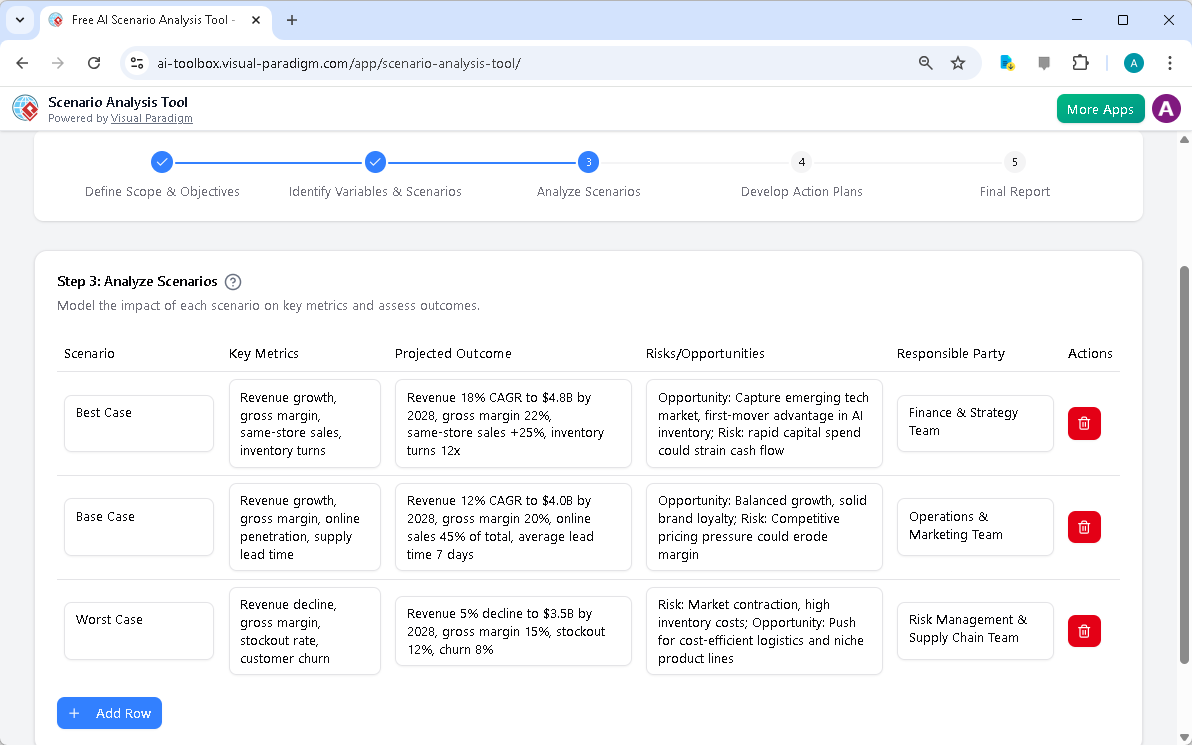
Now that the scenarios are defined, the analysis shifts to understanding their potential impacts on the business. The image below shows the tool’s interface for this phase. The analysis is structured around three distinct scenarios: Best Case, Base Case, and Worst Case. For each scenario, the tool prompts the user to model the impact on key metrics such as revenue growth, gross margin, and inventory turns. The projected outcomes are then detailed, providing a quantitative view of the potential future states. For example, the Best Case scenario projects a 18% CAGR in revenue, while the Worst Case scenario projects a 5% decline. This is followed by an assessment of the associated risks and opportunities. This analysis is vital for understanding the potential financial and operational consequences of each future, allowing the organization to prepare for both favorable and unfavorable conditions. The clear, tabular format makes it easy to compare the different scenarios and their implications side-by-side.
Step 4: Develop Action Plans
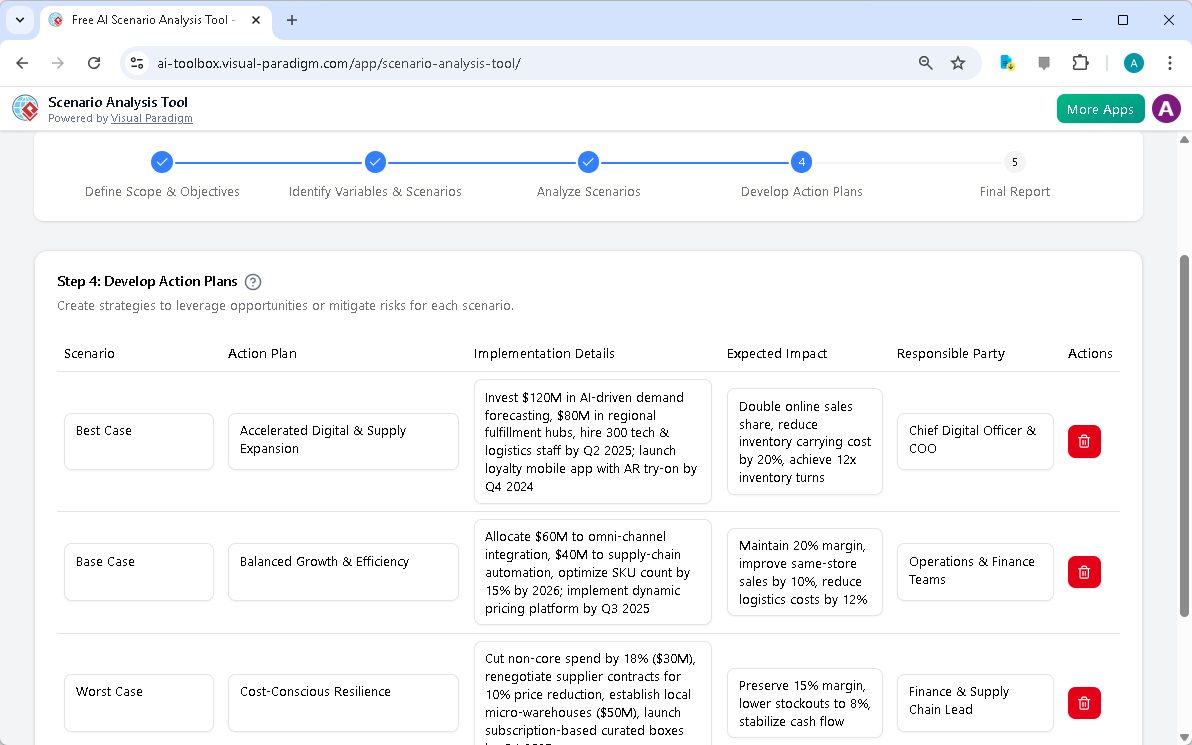
With a clear understanding of the potential future outcomes, the next step is to develop specific strategic responses. The image below demonstrates how the tool facilitates this process. For each scenario, a distinct action plan is proposed. In the Best Case, the action plan is “Accelerated Digital & Supply Expansion,” which includes investing $120M in AI-driven demand forecasting and launching a loyalty mobile app. In the Base Case, the plan is “Balanced Growth & Efficiency,” involving an investment of $60M in omnichannel integration and a dynamic pricing platform. For the Worst Case, the strategy is “Cost-Conscious Resilience,” which includes cutting non-core spending and establishing local micro-warehouses. Each action plan includes detailed implementation steps and expected impacts, ensuring that the organization has a clear roadmap for action. This step is critical for turning strategic insights into actionable strategies, ensuring that the organization is not only prepared for the future but is actively shaping it.
Step 5: Final Report and Strategic Insight
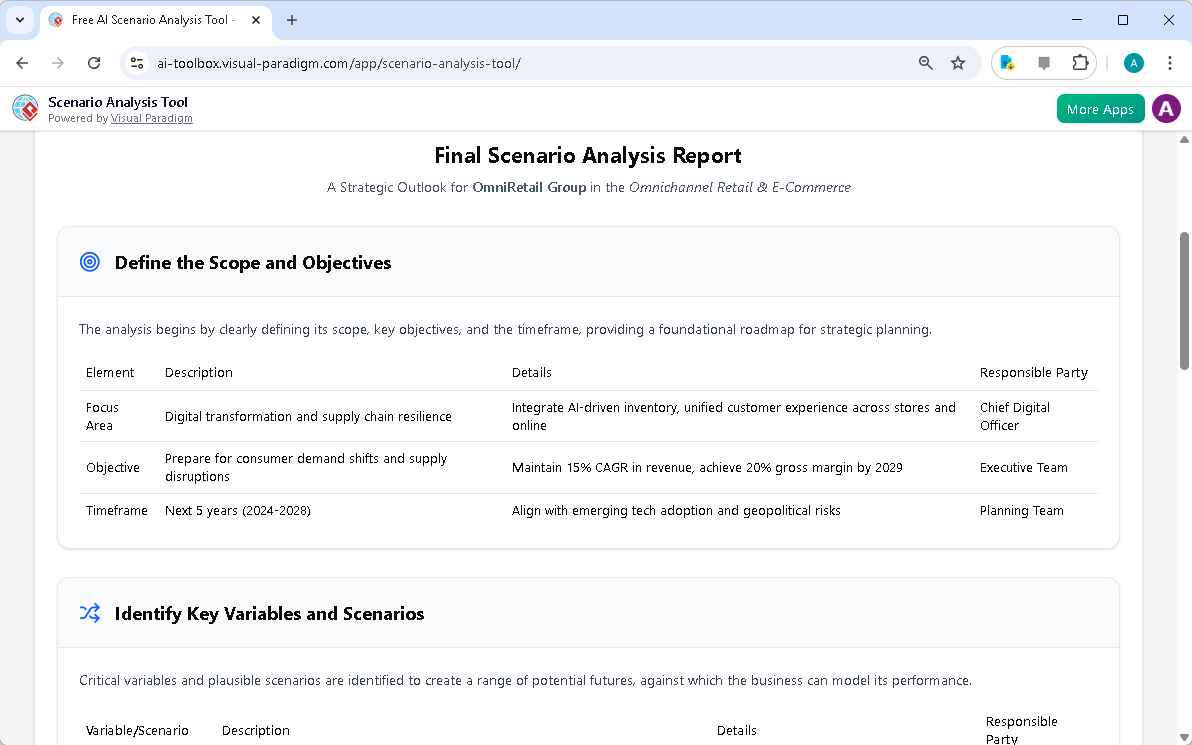
The final step is to consolidate all the analysis into a single, professional report. Image 6 displays the “Final Scenario Analysis Report,” which provides a comprehensive overview of the entire process. The report begins with a clear summary of the defined scope and objectives, followed by a detailed breakdown of the identified variables and scenarios. It then presents the analysis of impacts for each scenario, culminating in the development of strategic action plans. The report is structured to be easily digestible by leadership and stakeholders, providing a clear narrative of the potential future and the recommended course of action. This final document serves as a powerful tool for strategic dialogue and decision-making. It allows the organization to share its strategic foresight with the team, ensuring everyone is aligned and prepared for the future.
Conclusion: Empowering Strategic Foresight
The AI-Powered Scenario Analysis Tool from Visual Paradigm is a game-changer for businesses seeking to navigate an increasingly uncertain future. By providing a structured, step-by-step process, it simplifies the complex task of scenario planning, making it accessible to a wide range of users. The integration of AI technology allows for the rapid generation of a comprehensive analysis, which can then be refined and validated by the user’s own expertise. This powerful combination of automation and human insight enables organizations to develop more resilient and adaptive strategies. Whether you are a business strategist, risk manager, or entrepreneur, this tool can help you explore multiple plausible futures and make more robust decisions. The ability to save your analysis locally ensures that your strategic data remains private and secure. To experience the power of strategic foresight firsthand, try the AI-Powered Scenario Analysis Tool today.
Ready to build a resilient future for your business? Try the AI-Powered Scenario Analysis Tool now and discover how it can transform your strategic planning process.
Related Links
-
Free AI-Powered Scenario Analysis Tool for Strategic Planning: November 28, 2025 – Discover our free AI-driven Scenario Analysis Tool to future-proof your strategy. Anticipate change, assess risks, and build resilient plans with ease.
-
What is Scenario Planning: Scenario analysis is designed to allow improved decision-making by allowing deep consideration of outcomes and their implications . It enables professionals, and the public, to respond dynamically to an unknown future.
-
Free AI Scenario Analysis Tool – Strategic Foresight & Planning: Use our Free AI -enhanced Scenario Analysis Tool for step-by-step strategic planning. Input dynamic data, save progress, and create actionable plans.