


Conducting a thorough competitive analysis is essential for any business aiming to succeed in a crowded market. Visual Paradigm’s AI-Powered Competitive Analysis Tool provides a structured, efficient way to gain a deep understanding of your competitors and develop a winning strategy. This feature deep dive showcases how the tool guides users through a complete analysis, from defining objectives to generating a professional report. The process is designed to be intuitive, ensuring you can quickly gather insights and make informed decisions. This guide will walk you through the entire workflow, demonstrating how the AI-powered tool can accelerate your competitive intelligence.
For a business in the fitness technology and digital wellness services sector, understanding the competitive landscape is critical. The Visual Paradigm AI-Powered Competitive Analysis Tool simplifies this process by offering a guided, 6-step framework. It begins with defining clear objectives, such as benchmarking features, pricing, and customer retention strategies against leading platforms. The tool then uses AI to generate a comprehensive analysis, identifying key competitors like Peloton, Apple Fitness+, Nike Training Club, and Fitbit Premium. By following this structured process, businesses can uncover critical insights and develop actionable strategies to gain a competitive edge.
-
Define Objectives and Scope: The first step is to clearly outline the goals of your analysis.
-
Identify Key Competitors: The tool helps you list and categorize your main rivals.
-
Gather Data: It provides a framework for collecting relevant information on competitors.
-
Analyze Competitive Factors: You can compare your company against competitors on key metrics.
-
Identify Opportunities and Threats: The tool helps you spot potential advantages and risks.
-
Summarize and Recommend Actions: Finally, it compiles your findings into a strategic report.
Step 1: Define Objectives and Scope
Before gathering data, it’s crucial to define the goals of your competitive analysis. The AI-Powered Competitive Analysis Tool begins with a clear, structured approach. In this step, users input their business context, such as the industry and a brief description of their product or service.
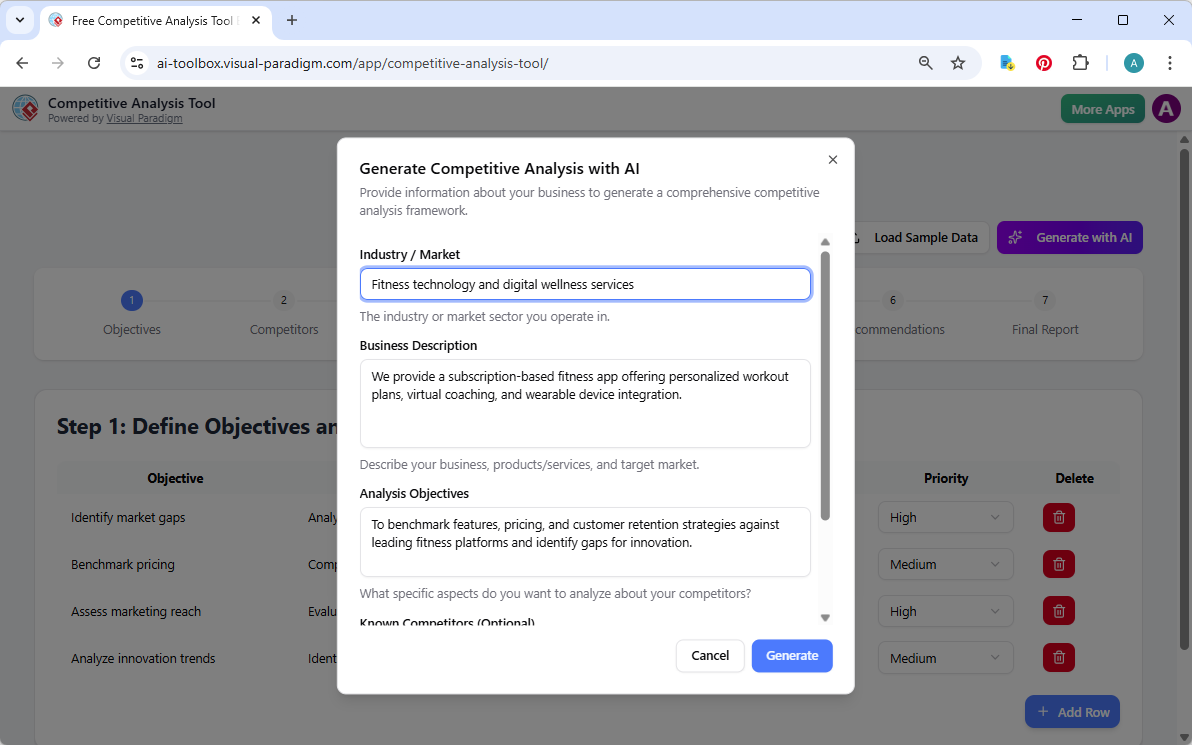
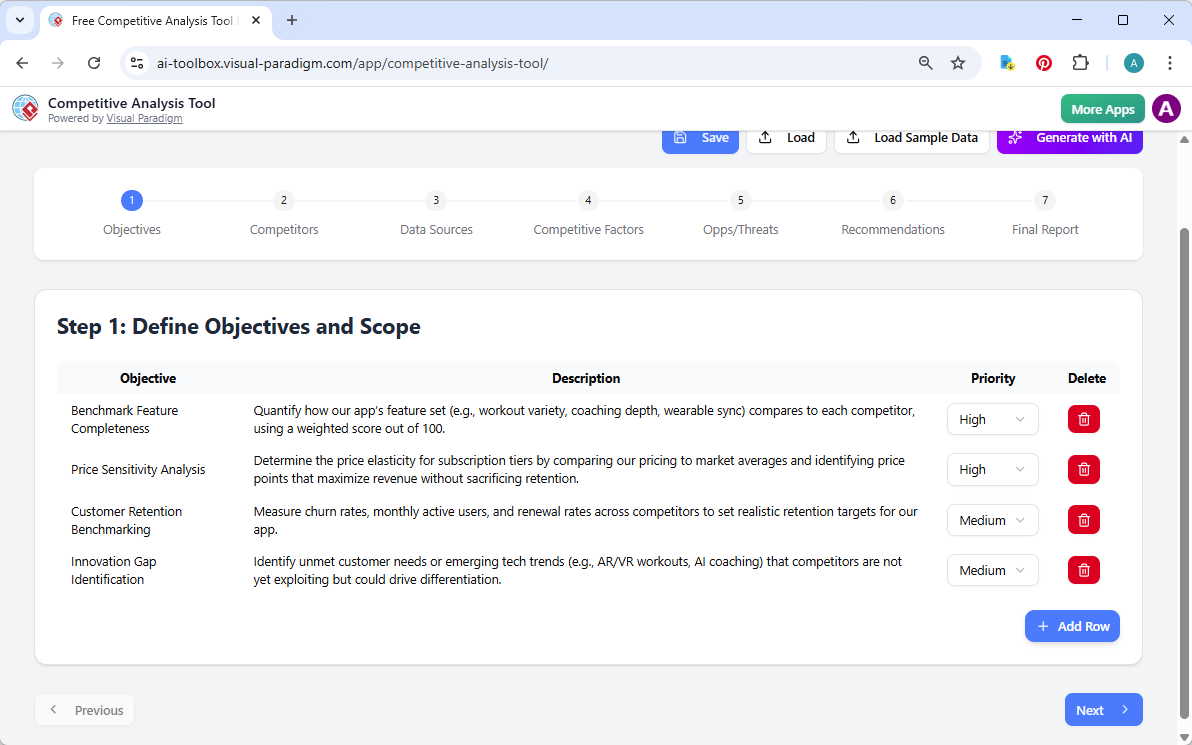
The tool then uses this information to generate a list of relevant objectives. For a fitness app, objectives might include benchmarking features, analyzing pricing sensitivity, and assessing customer retention strategies. The tool presents these objectives in a table format, allowing users to prioritize them and add new ones as needed. This step ensures the analysis is focused and aligned with the business’s strategic goals.
Step 2: Identify Key Competitors
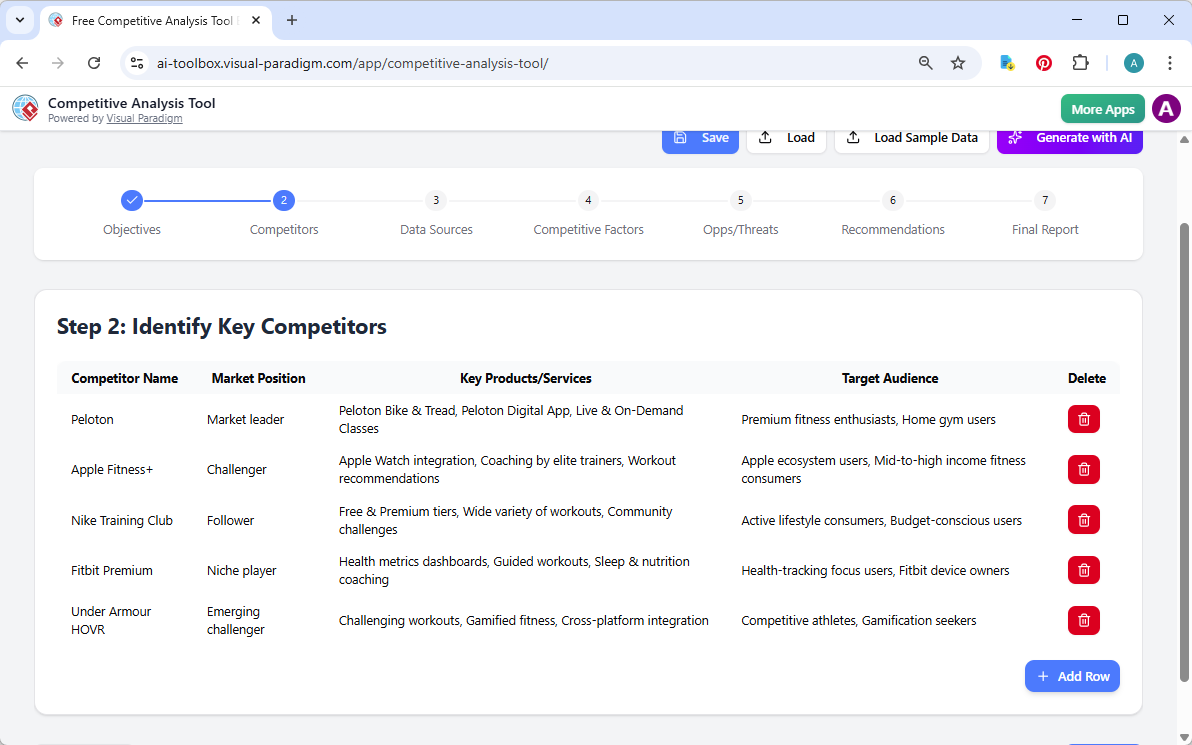
Once the objectives are defined, the next step is to identify the key competitors in the market. The tool provides a dynamic table where users can input competitor names, their market position, key products or services, and target audience. The AI generates a list of potential competitors based on the initial business context. For the fitness app example, competitors like Peloton, Apple Fitness+, Nike Training Club, and Fitbit Premium are identified. The tool allows users to add new competitors or modify existing entries, ensuring a comprehensive analysis of the competitive landscape. This step is essential for understanding the strengths and weaknesses of each rival.
Step 3: Gather Data
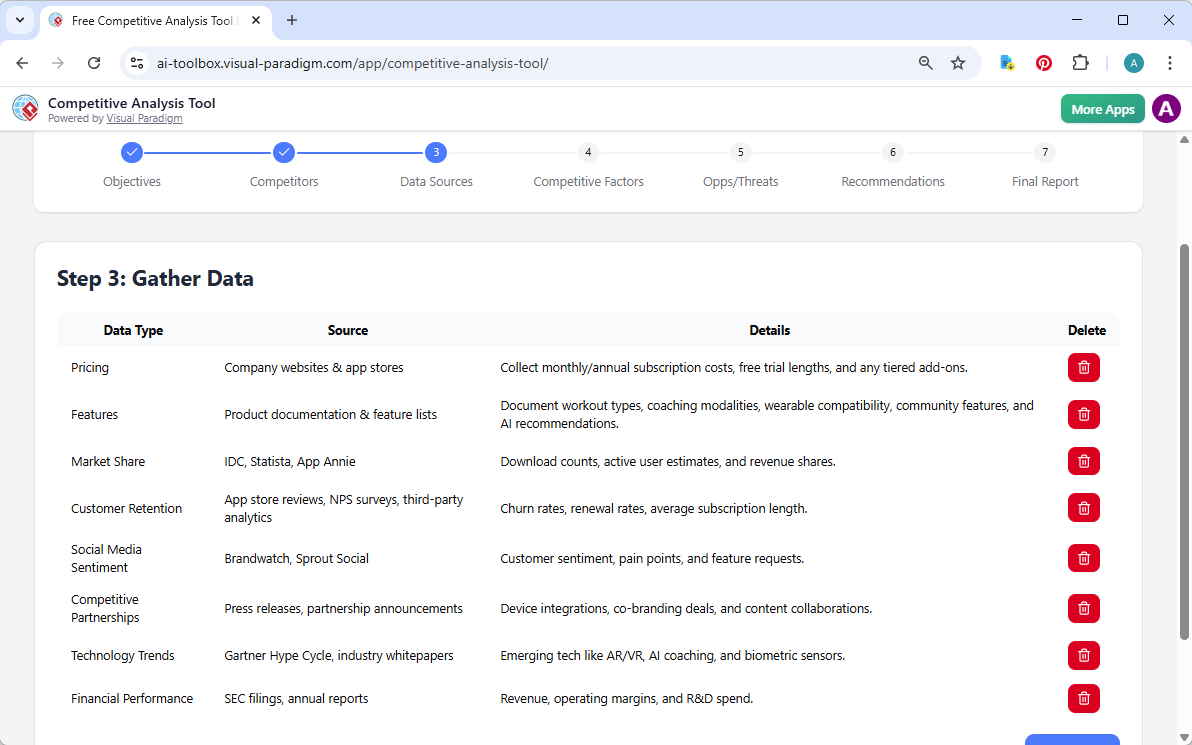
With the competitors identified, the analysis moves to gathering data. The tool provides a structured table for collecting information on various data types, including pricing, features, market share, customer retention, social media sentiment, competitive partnerships, technology trends, and financial performance. Each data type has a designated source and details section. For instance, pricing data can be collected from company websites and app stores, while market share data can be sourced from industry reports. The AI suggests relevant data sources, saving users time and ensuring a thorough analysis. This step ensures that the analysis is based on reliable and comprehensive data.
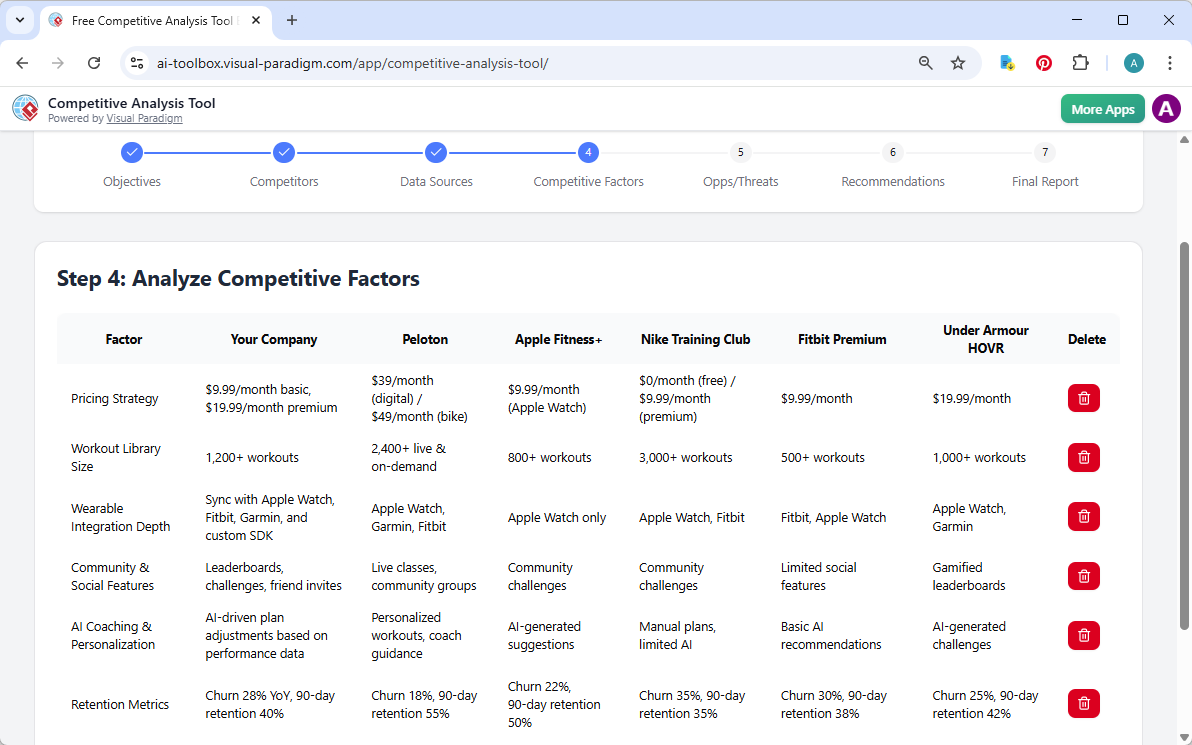
Step 4: Analyze Competitive Factors
This step involves comparing your company against competitors on key factors. The tool provides a comparative table where users can input data for each factor, such as pricing strategy, workout library size, wearable integration depth, community features, AI coaching, and retention metrics. The AI populates the table with data based on the user’s input and research. For the fitness app, this step might reveal that while the company has a strong feature set, competitors like Nike Training Club and Fitbit Premium have larger workout libraries and better wearable integration. This analysis helps identify areas where the company can improve and differentiate itself.
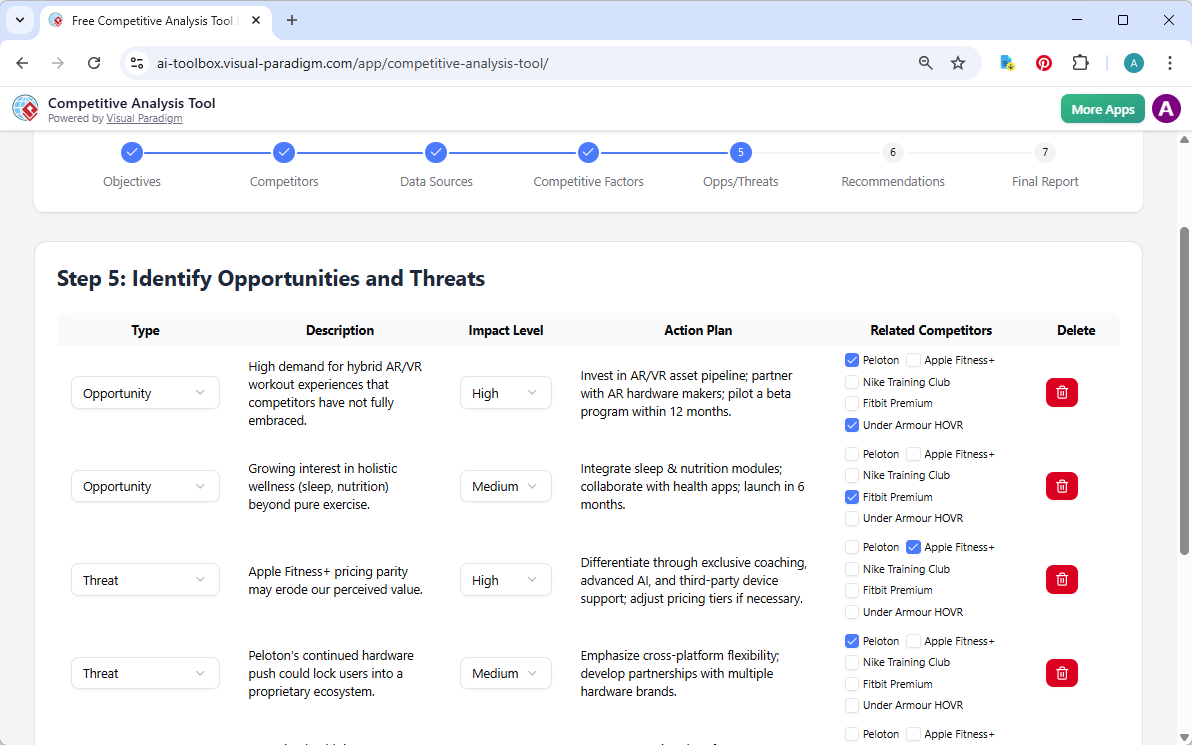
Step 5: Identify Opportunities and Threats
After analyzing the competitive factors, the tool helps users identify opportunities and threats. The AI generates a list of potential opportunities, such as a high demand for hybrid AR/VR workout experiences, and threats, such as Apple Fitness+ pricing parity eroding perceived value. Users can prioritize these opportunities and threats based on their impact level and develop action plans. The tool allows users to associate each opportunity or threat with specific competitors, ensuring a targeted approach. This step is crucial for developing strategic recommendations that leverage strengths and mitigate weaknesses.
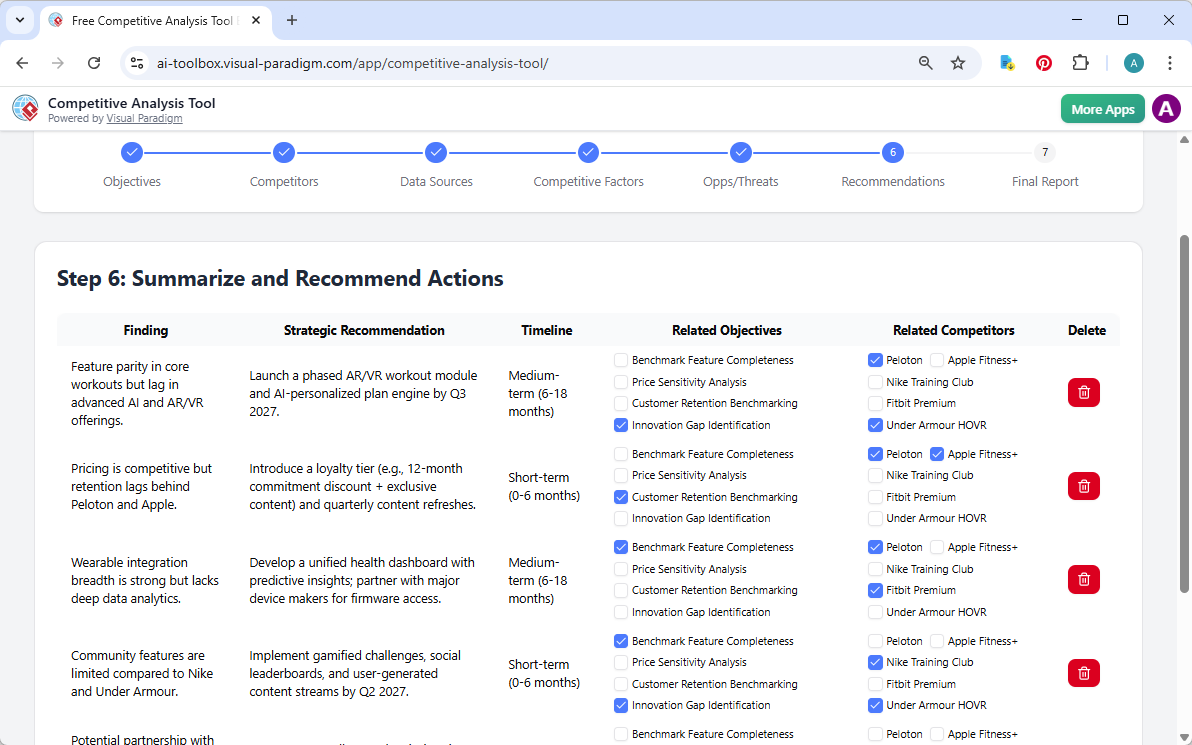
Step 6: Summarize and Recommend Actions
With the analysis complete, the tool consolidates all findings into a strategic summary. The AI generates a list of strategic recommendations based on the analysis. For the fitness app, recommendations might include launching a phased AR/VR workout module and introducing a loyalty tier. The tool provides a timeline for each recommendation, helping users prioritize and plan their actions. This step ensures that the analysis is not just a collection of data but a roadmap for strategic decision-making. The recommendations are clear, actionable, and directly tied to the analysis findings.
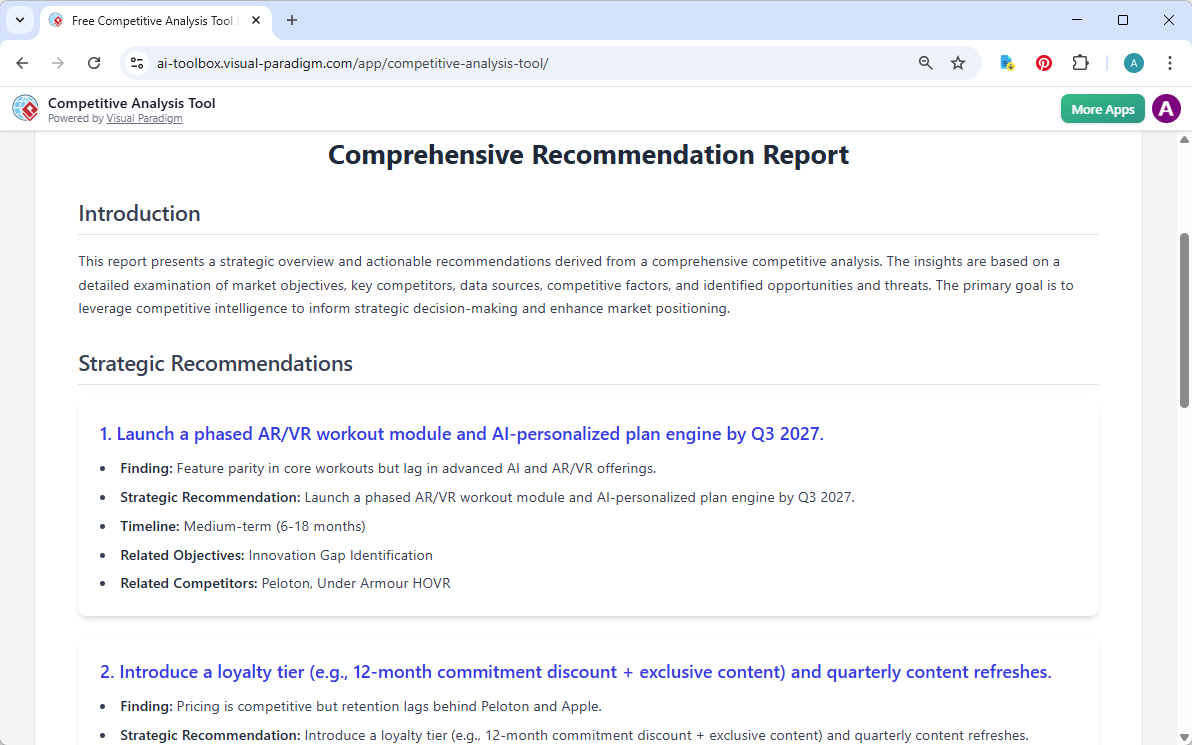
Final Report: Comprehensive Recommendation Report
The final step is to generate a professional, comprehensive recommendation report. The tool compiles all the information from the previous steps into a single, easy-to-read document. The report includes an introduction, strategic recommendations, and a summary of the analysis. It provides a clear overview of the competitive landscape and actionable insights for the business. Users can print the report or save it as a PDF, making it easy to share with stakeholders. This final report is a powerful tool for communicating the results of the analysis and driving strategic decision-making.
Conclusion
Visual Paradigm’s AI-Powered Competitive Analysis Tool offers a powerful, structured approach to gaining competitive intelligence. By following a guided 6-step process, users can define objectives, identify key competitors, gather data, analyze competitive factors, identify opportunities and threats, and generate a comprehensive report. The AI-powered features accelerate the analysis process, providing a professional starting point that users can refine with their own research. This tool is ideal for business strategists, product managers, marketing professionals, and entrepreneurs who need to understand their market landscape and develop differentiated strategies. By using this tool, businesses can make informed decisions, reduce risk, and enhance their market positioning.
Ready to gain a competitive edge? Try the AI-Powered Competitive Analysis Tool today and discover how it can transform your strategic planning process.
Related Links
Visual Paradigm provides a comprehensive suite of strategic analysis tools, including Porter’s Five Forces, SWOT, and PESTLE, to facilitate data-driven business decisions. These tools allow teams to examine the external business environment, identify capability gaps, and compare competitor performance across multi-dimensional metrics. Additionally, specialized tools such as perceptual mapping and radar charts help visualize brand positioning relative to rivals to support strategic planning and market analysis.
-
How to Use Radar Charts for Competitive Analysis: A practical tutorial on comparing competitor performance across key metrics to inform strategic decision-making.
-
Radar Chart for Competitor Analysis: A Data Visualization Guide: Explains using radar charts to compare competitors across multiple dimensions for market analysis and positioning.
-
Comprehensive Suite of Strategic Analysis Tools: Details an integrated suite for Porter’s Five Forces, SWOT, and PEST analysis to support data-driven decisions.
-
Strategic Analysis Tool for Business Planning: An online platform designed to improve informed decision-making through various strategic modeling frameworks.
-
Perceptual Map Tool for Brand Positioning: A reliable tool for creating perceptual maps to visualize brand positioning and customer perceptions relative to rivals.
-
Strategic Analysis with PESTLE & Porter’s Five Forces Analysis: An in-depth guide to using these critical techniques to examine the external competitive environment.
-
Multi-Attribute Brand Perceptual Map: A specialized template for visualizing brand positioning across multiple consumer perception attributes.
-
SWOT Analysis Tutorial (Including Five Forces): A step-by-step guide for creating professional SWOT, PEST, and Five Forces diagrams online to support strategic evaluation.