
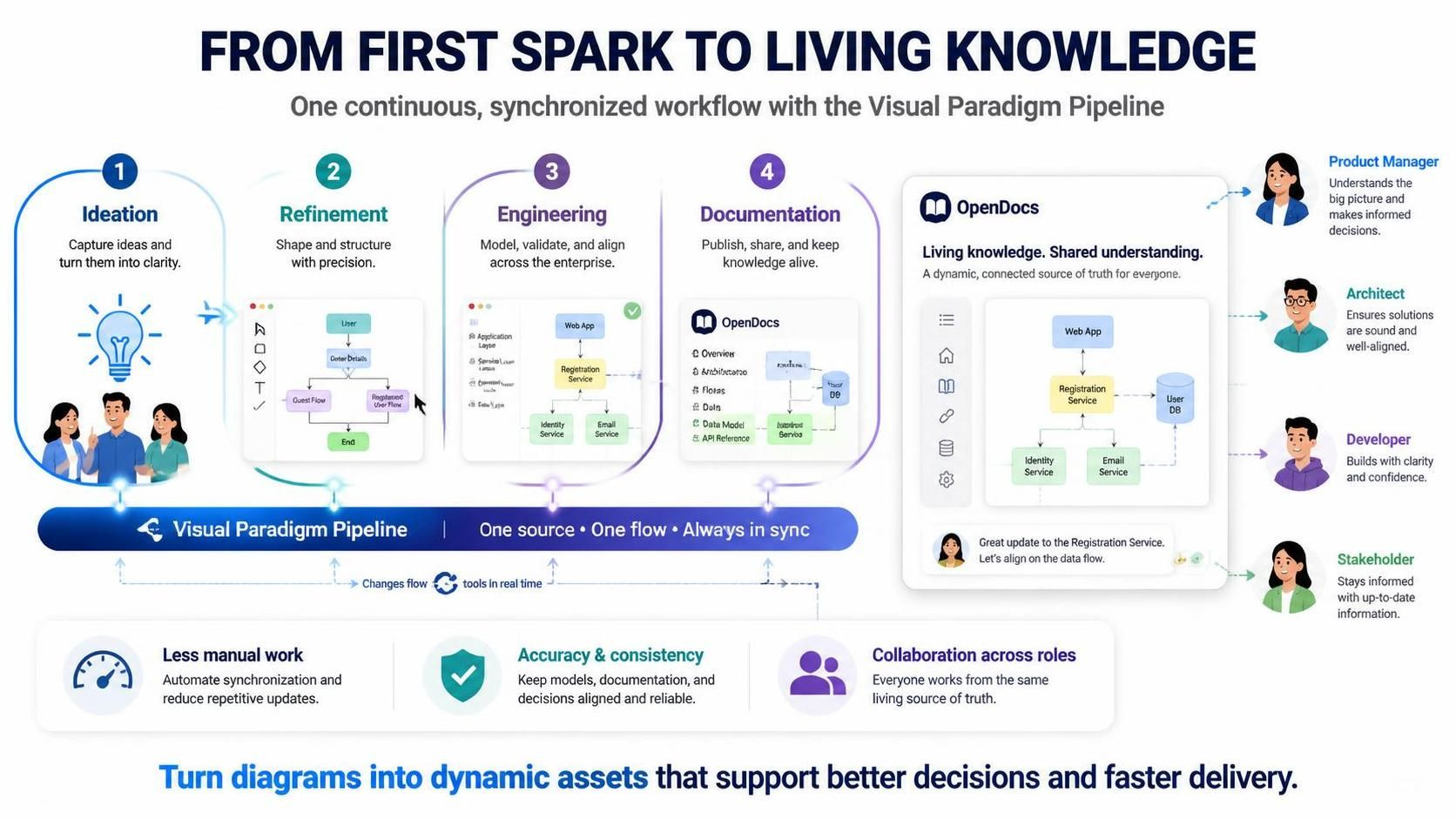
In the modern software development lifecycle, the gap between high-level business ideation and low-level technical implementation is often bridged by a chaotic mess of disconnected documents and static diagrams. The Visual Paradigm AI Ecosystem fundamentally changes this narrative. It introduces a continuous, synchronized workflow that transforms diagrams from static artifacts into dynamic, living assets.
This tutorial explores the four-pillar architecture of the Visual Paradigm Pipeline: Ideation, Refinement, Engineering, and Documentation. We will walk through how this system architecture ensures that a single source of truth drives decision-making from the product manager to the final stakeholder.
1. Ideation: Capturing Ideas and Turning Them into Clarity
The journey begins at the “First Spark.” In traditional workflows, ideas often get lost in emails or sticky notes. The Visual Paradigm pipeline starts by allowing teams to capture these raw concepts and immediately visualize them.
- The Concept: This phase focuses on clarity. It is where the “User” entity is first defined, and the initial “Guest Flow” or “Registered User Flow” is sketched out.
- The Goal: To turn abstract thoughts into a structured visual representation that can be discussed and validated before a single line of code is written.
2. Refinement: Shaping and Structuring with Precision
Once an idea is captured, it must be refined. This is the bridge between a rough sketch and a precise specification. In the Visual Paradigm ecosystem, this is where the “Open Docs” model is often created.
During this phase, you are not just drawing shapes; you are defining the logic. For example, a simple flowchart is transformed into a detailed model where:
- Gate Logic: You define conditions (e.g., “Guest” vs. “Registered”).
- Process Definition: You specify exactly what happens at each step.
The architecture ensures that as you refine the model, the diagram updates in real-time. This eliminates the common error of updating a Word document but forgetting to update the corresponding Visio diagram.
3. Engineering: Modeling, Validating, and Aligning
The third pillar connects the conceptual models to the actual engineering reality. This is where the “Engineering” phase takes place, often involving the creation of specific application layers and data models.
In this stage, the system validates the model against engineering standards. You might see:
- Application Layer: Defining the “Web App” and its components.
- Service Architecture: Breaking down the “Registration Service” into sub-components like “Identity Service” and “Email Service.”
- Data Modeling: Mapping the “User DB” and its relationships.
The “Visual Paradigm Pipeline” acts as the central nervous system here. It ensures that when a developer modifies the “Web App” component, the change is immediately propagated to the architectural view and the data model. This synchronization is critical for maintaining Accuracy & Consistency.
4. Documentation: Publishing and Keeping Knowledge Alive
The final phase of the pipeline is Documentation. The goal here is to create “Living Knowledge.” Instead of generating a static PDF that is outdated the moment it is published, the system generates dynamic documentation.
OpenDocs serves as the “Dynamic, Connected Source of Truth.” It aggregates the information from the Ideation, Refinement, and Engineering phases into a comprehensive report. This report includes:
- Overview: High-level summaries.
- Architecture: Detailed system views.
- Flows: Data flow diagrams.
- Data Models: Entity relationship diagrams.
- API References: Interface specifications.
The Role of OpenDocs: Living Knowledge
OpenDocs is the culmination of the pipeline. It is not just a repository; it is a collaborative platform.
- Real-Time Updates: As changes flow through the pipeline (indicated by the “Changes flow” arrows in the system diagram), OpenDocs updates automatically.
- Collaboration: It allows stakeholders to leave comments, such as “Great update to the Registration Service. Let’s align on the data flow,” ensuring that feedback is contextual and actionable.
Conclusion: From Static Artifacts to Dynamic Assets
The transition from “First Spark” to “Living Knowledge” is not just a marketing concept; it is a technical architecture that enforces discipline and collaboration. By leveraging the Visual Paradigm Pipeline, teams can:
- Reduce Manual Work: Automate synchronization and reduce repetitive updates.
- Ensure Consistency: Keep models, documentation, and decisions aligned and reliable.
- Empower Roles: Whether you are a Product Manager, Architect, Developer, or Stakeholder, everyone works from the same living source of truth.
This workflow transforms diagrams from static artifacts into dynamic assets that drive better decision-making and faster delivery.